Monthly Archives: May 2013

The Search Continues for William Niven’s Buried Cities; Part 1

When William Niven closed up shop of his archaeological discoveries in Mexico City to move back to the United States, the entire contents of his store was carefully placed in wooden boxes for the trip. Niven had excavated in Guerrero and the Valley of Mexico for three decades and been allowed to keep duplicates of everything he had found. Literally thousands of relics were found by Niven, including the 2600 tablets that were made famous through James Churchward’s books.

From 'Children of Mu' (facing page 41)

From ‘Children of Mu’ (facing page 41)


According to Buried Cities, Forgotten Gods, William Niven’s biography, he had an arrangement with the Mexican government that he would give them the best example of any relic, but he was permitted to keep duplicates. Niven donated thousands of relics to the National Museum and rightly felt that he was entitled to maintain possession of his collection. Referencing Buried Cities, Forgotten Gods again, Ramon Mena, head of the archaeological division at the National Museum, estimated that Niven had excavated 40,000 tons of earth and donated more than $10,000 worth of material to the Museum at no cost to the Mexican government. In addition to the material donated to the Mexican National Museum, he also contributed items to the Peabody Museum. These artifacts are known, however the whereabouts of his collection from his Mexico City storefront remains a mystery.

In the past decade, fellow researchers have approached various Texas institutes of higher learning about his discoveries to no avail. Needless to mention is that they were not the first to search for the artifacts. In Part 2, we’ll examine one such earlier attempt.

Another Lost Sunken City Found

In an article entitled, “Lost city of Heracleion gives up its secrets,” the details of another ancient sunken city have been reported. Uncovered off the coast of Egypt and initially rediscovered in 2000, the city of Heracleion has slowly been revealing it’s treasures from 150 feet beneath the Bay of Aboukir. Also known as Thonis to the Greeks, the artifacts recovered from the site have amazed archaeologists.

The city disappeared some 1200 years ago and was known in the present era only from a few ancient texts and some inscriptions. It was originally built in the eighth century BCE. The site is now 6.5 kilometers off the coast and occupies an area of 11 by 15 kilometers.

This is another example of sunken features that have arisen from obscurity and/or legend to change our understanding of history. Here are some other examples:
Sunken Landmass(es) Found
Another Submerged Civilization Rises
More Talk of Sunken Continents in the Indian Ocean
James Churchward’s Western India Discovery?
Baltic Sea Discovery Reveals Ancient Construction?
More on Doggerland…

Have a great day.

Ancient Siberian Rock Formation – Evidence of Great Uighur Empire?

According to Professor Vitaly Larichev, of the Institute of Archaeology and Ethnography at the Siberian Branch of the Russian Academy of Sciences, the Sunduki site in Siberia is a 16,000 year old astronomical observatory. These statements are recorded in the Siberian Times article, “Is this the oldest astronomical observatory in the world dating back 16,000 years?.”

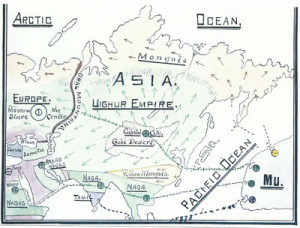
GUE_mapsm

According to my great-grandfather, James Churchward, the Great Uighur Empire (see map above) was the principal colony of the lost continent of Mu and was thousands of years old at it’s height some 17,000 years ago. The fact that artifacts of such age have been discovered in the vicinity provides hope that evidence of the Great Uighur Empire has been found.

Of course, further study and research is necessary to show a link between the ancient Uighurs and the people that inhabited this area and many patiently await the confirmation.

Have a great day.