James Churchward and Ceylon (Sri Lanka)

A recent correspondence (edited):

Dear Jack,

It has been a while since I promised to write to you about what I found out in Sri Lanka.
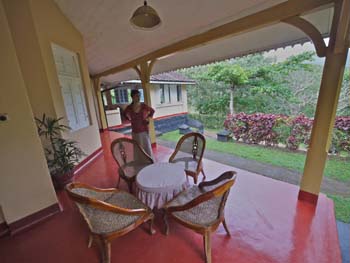

Government Guest House

Government Guest House

I have eventually been there in October last year – traveling with my wife and a friend. I tried to find out a little bit more about the two tea estates – Hatherleigh and Oakhampton, which your great grandfather had once managed. I found only one remaining: Hatherleigh.
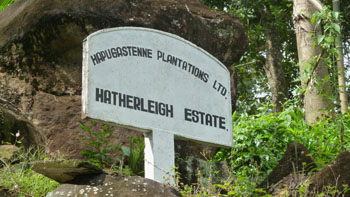

Hatherleigh Estate Sign

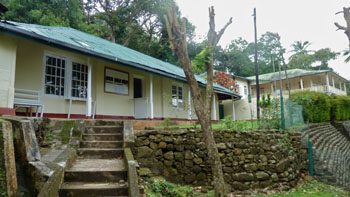
Old Office Building, Hatherleigh Estate


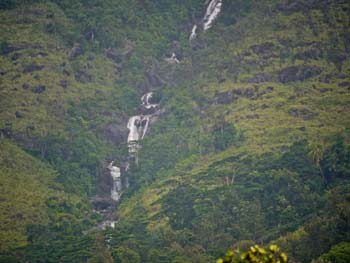
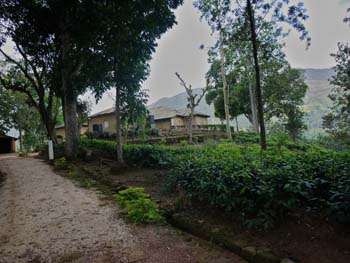
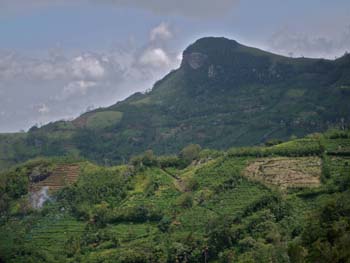
I had contacted Finlay’s beforehand, who are now managing the estate. The district manager, Mr. Dhayan, connected me with the estate manager, Mr. Upendra, who was very generous  and took a whole day off to show us around and explain as much as he himself knew about the history. Hatherleigh estate is in a not so frequently visited area but lies in an enchanting setting. There is a long waterfall coming down in the middle of the estate. Most of the land is mixed culture – quite special. So, tea bushes are not growing in a near mono-culture as in the highlands but are mixed with small orchards and even jungle. The estate directly borders Sinaraja Rainforest, which is a National Park today – but also not so frequently visited due to its enormous population of leeches. We found some of them while walking on the estate, or rather they spotted us.
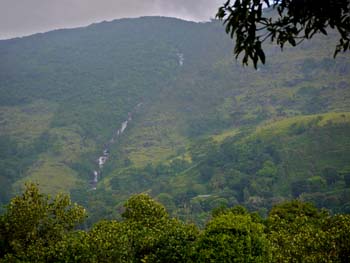

Waterfall, Hatherleigh Estate

Waterfall, Hatherleigh Estate

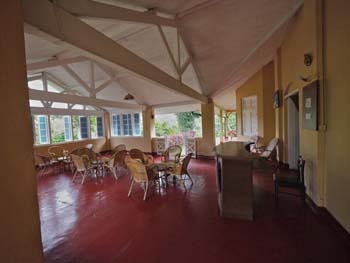
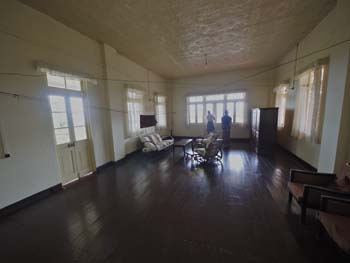
Visitors/Guest Bungalow, Hatherleigh Estate

Interior, Visitors/Guest Bungalow Hatherleigh Estate

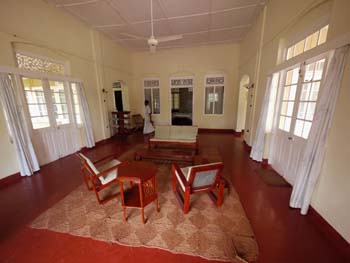
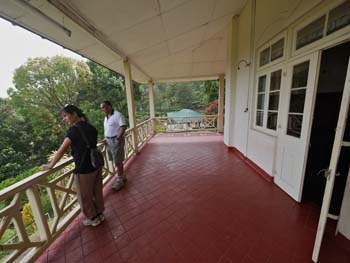
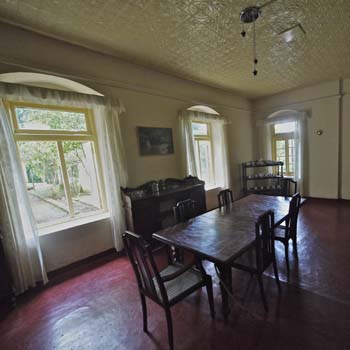
As expected, there are not too many really old buildings left on the estate. The manager bungalow is probably from the late 19th century and so  are some of the other buildings except the factory, which has burnt down in the 1960ies and was rebuilt on a different site. Some of them could have been there in this or another form at James’ times. From a 1912 map it seems that the locations of the main buildings have not changed though – being the manager bungalow, the nearby office building, another management bungalow and the charming guest bungalow with its direct view on the majestic waterfall.
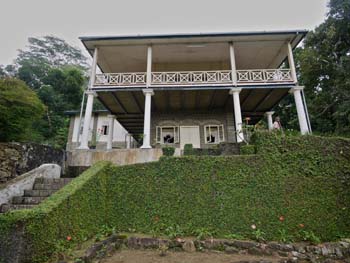

Management Bungalow, Hatherleigh Estate

Interior, Management Bungalow, Hatherleigh Estate

Management Bungalow, Hatherleigh Estate

Interior, Management Bungalow, Hatherleigh Estate


The estate’s boundaries are still the same as when Churchward had been there. The manager told us that this is the case with many estates in Sri Lanka. Even the names remained largely unaltered.

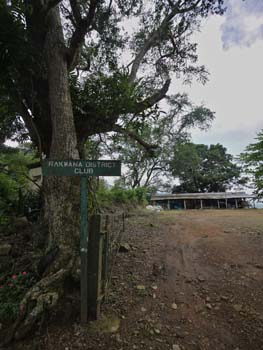
I was not able to find out more about the second estate, which I presume was not far away and maybe neighboring. I only asked a handful of people though and since I could not take too much time due to my friend’s need for ‘real holiday’, we didn’t make it to Ratnapura where they have a local museum. The latter should be a good option for the next time, as well as the new planters’ club there. An old planters’ club was in Rakwana but is now defunct. There is a photo of it though.


Planter’s Club, Rakwana

Planter’s Club, Rakwana

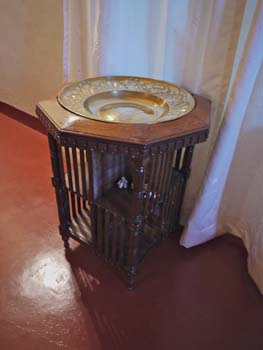
Brass Bowl, Management Bungalow, Hatherleigh Estate

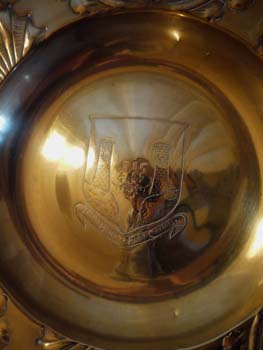
Brass Bowl, Interior, Management Bungalow, Hatherleigh Estate
The inscription on bowl reads: “Statio bene fida carinis” translated as ‘A safe place (harbor) for trustworthy ships’ and is the motto of the city of Cork.


Then there is the tea-museum in Kandy which might hold some additional info too.

Rakwana is a very small town in almost walking distance. Hatherleigh is de facto Rakwana and Rakwana is there because of the estate.

Regarding the other estate, Oakhampton: The manager of Hatherleigh told me that today’s area where tea is actually planted is much smaller than it was in the 19th century. Apparently they had cut down not on the size of the estate, but on the size of planted areas. As always he complained about the economical situation of the tea industry and that they are not easily able to find workers anymore without giving them additional incentives, etc. I somehow believed him – since obviously the tea exchange in Colombo makes big cuts and the producers are left a bit between them and the labor market. Though Ceylon today is the world’s biggest tea producer, it seems to be not highly profitable for the estates themselves. We even ‘accidentally’ participated in an opening ceremony for a small worker’s rest house.
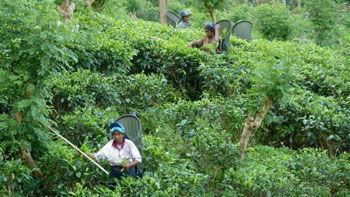

Collecting Tea, Hatherleigh Estate

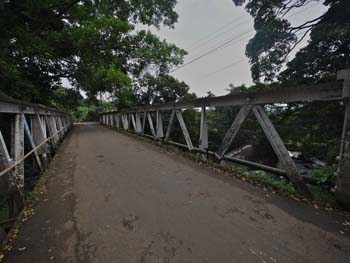
Old bridge, Hatherleigh Estate

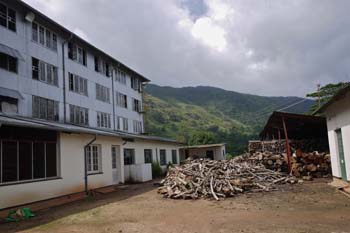
New Factory, Hatherleigh Estate

Visitors/Guest Bungalow Hatherleigh Estate


Just some additional figures: The estate employs around 300 workers all together plus 60 at the factory. They are producing 16 sorts of (black) tea with different rollings, tips and whole leaves, like Orange Pekoe, etc. Of course we drank some and I found it very good. It’s rare to get tea that is not blended and really comes from one place only.
On top of guiding us around Mr. Upendra, the estate manager, gave us each a package of F.B.O.P tea and if you or anybody in your family drinks black tea, I would really like to send you one of these packages. Just let me know!

I know agree that the “temple” with the Nacaal tablets has to be in South India and not Ceylon (which back then was counted under “India”). There seems to be no major temple anywhere near Rakwana, almost certainly not a very old one. Though I suspected that earlier, I find it always rewarding to start looking from the fringes towards the center.

However, Hatherleigh Estate lies in an area that is considered as the heartland of the Veddhas, the most ancient tribes that are left over from Lanka’s original population. They are somehow similar to Indonesian or Australian Aborigines. Also I found that the area around Hatherleigh was one of the certainly more ‘mystical’ places from the sites we have seen during our 2-week traveling. Deep gorges, dense jungle and steep hills mingling with fog.
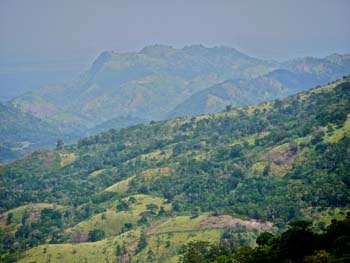

On the road from Rakwana to Surya Kanda

On the road from Rakwana to Surya Kanda

Rediscovery of the Naacal Tablets March 2011 Update

I recently spoke with Thomas Ritter concerning the rediscovery of the Naacal Tablets

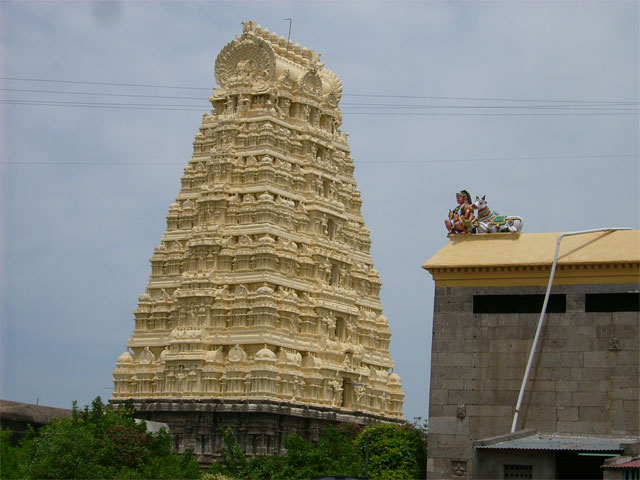
Here are the images:


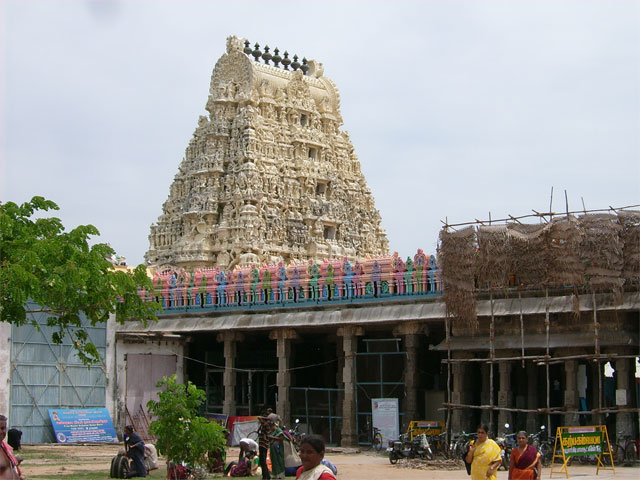
Gopuram (Gate Tower) of the Sri Ekambaranatha Temple in Kanchipuram

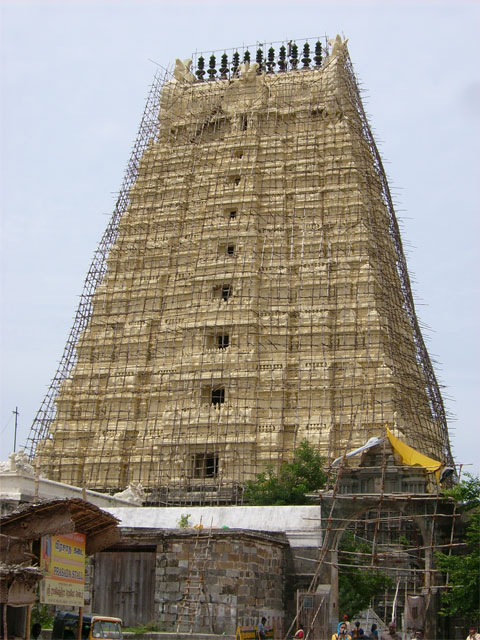
and here another picture of the Gate Tower of the Shree Ekambaranatha Temple at Kanchipuram

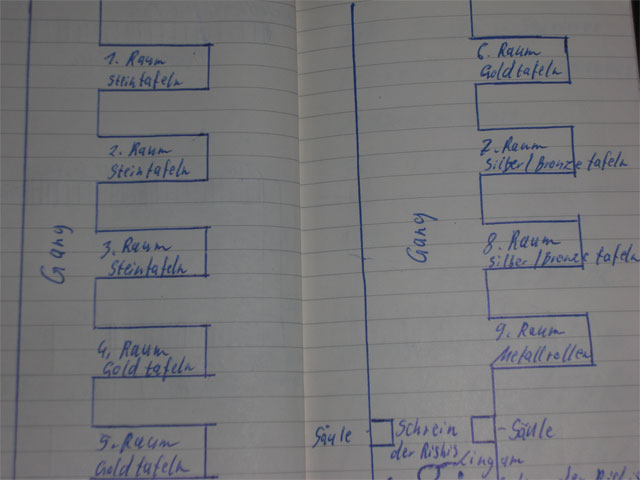
I made a map from the subterranean tunnel system in which the library is stored away

view of the temple


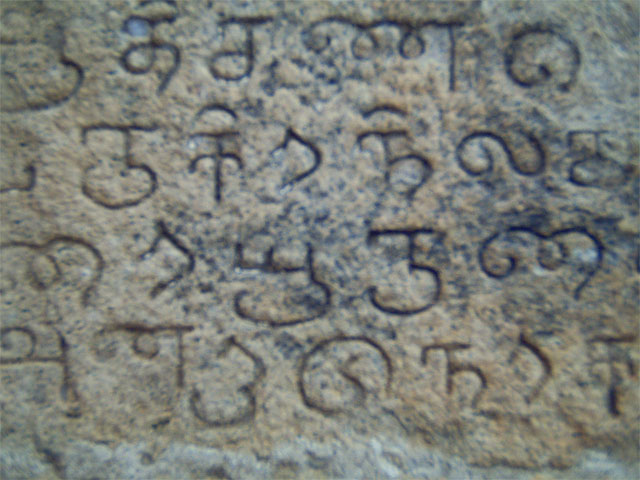
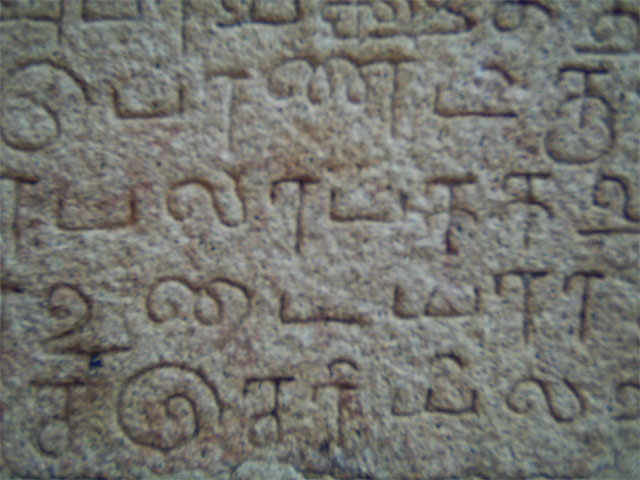
In the subterranean system there are 10 chambers. In 9 chambers they stored the tablets. In the first 3 chambers the tablets are made fom solid black stone. In the next 3 chambers the tablets are made from gold. In tha last 3 chambers the tablets made from solid silver and brass and an mix of metals wat they callad pachalogha – the so called five holy metals. The 10th chamber is like an small temple with an black Shiva lingam and the statues of the seven holy rishis. In the 9 chambers you find some inscriptions at the walls – they describe the rishis puranas, what means, the live and the deeds of the rishis. I made some pictures from these inscriptions.

second inscription

third inscription

fourth inscription

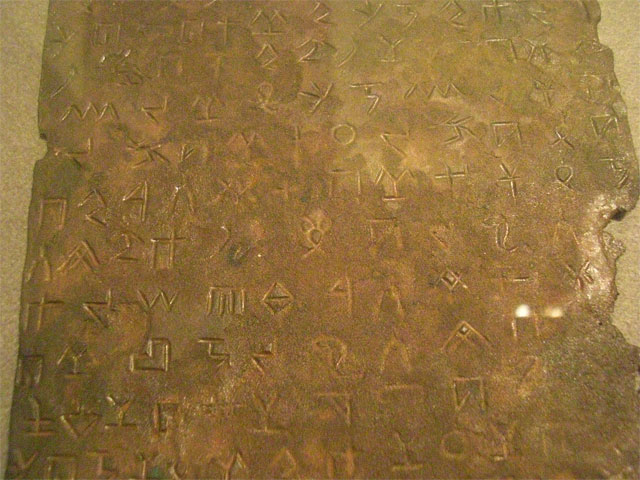
At chamber no. 1 and chamber no. 4 the priest, who guided me down there to to library, allowed me to take some pictures of the tablets. As attachment of this mail you see one tablet from chamber no. 1

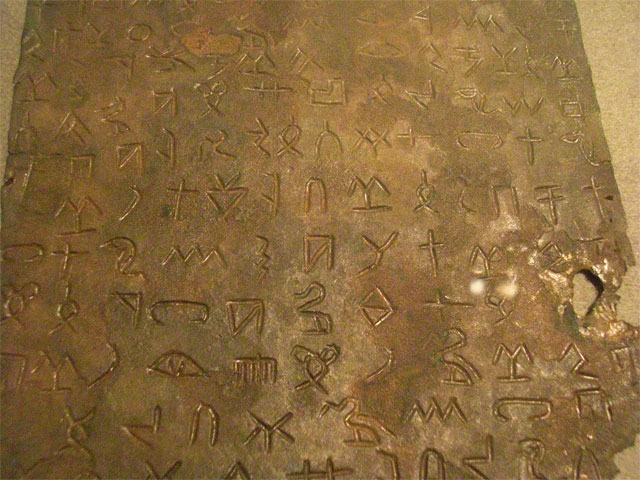
At chamber no. 4 the priest only allowed me to take pictures from 2 tablets, not from all this books there. The 2 tablets he showed me, are a ittle bit damaged. But you can see clearly the inscriptions.

The second tablet from chamber no. 4

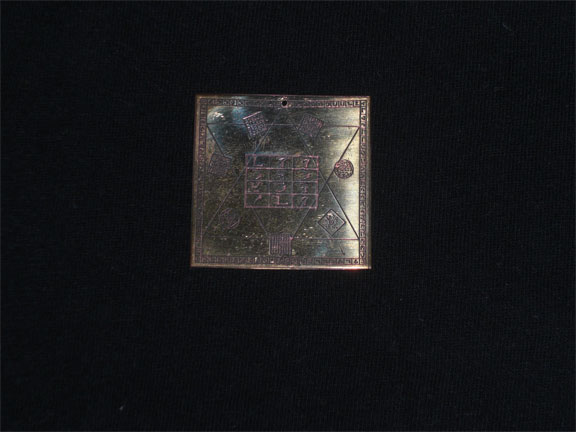
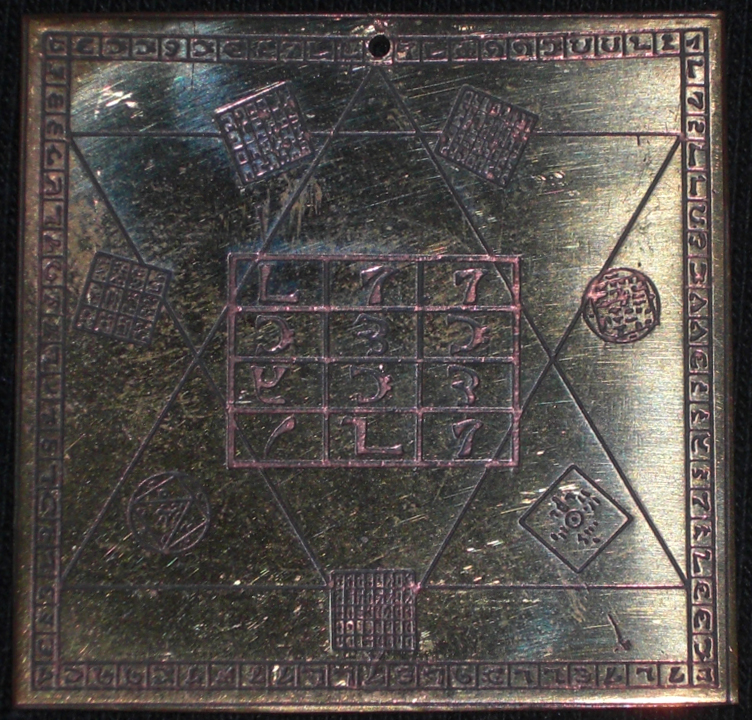
Athe end of my visit at this subterranean library the priest, who guided me (his name is Pachayappa), presented a small gift to me. This very small tablet is made from brass, in my opinion. I am not very sure, if it was part of the tablets down there at the library of MU or it was made later. But Pachayappa told me, that the inscriptions at these small tablet are some kind of key to the understanding of the inscriptions of the other tablets. This small item is still with me and I am trying to breach its code. But surely I will need a little help.

Closeup

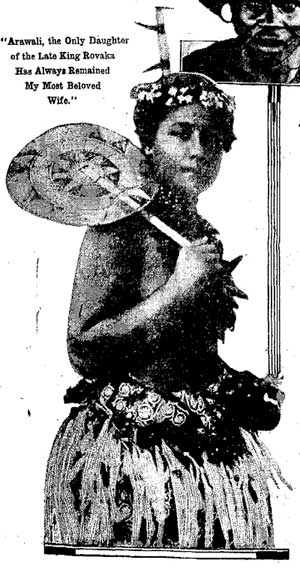
Another Mystery Solved – Princess Arawali Uncovered

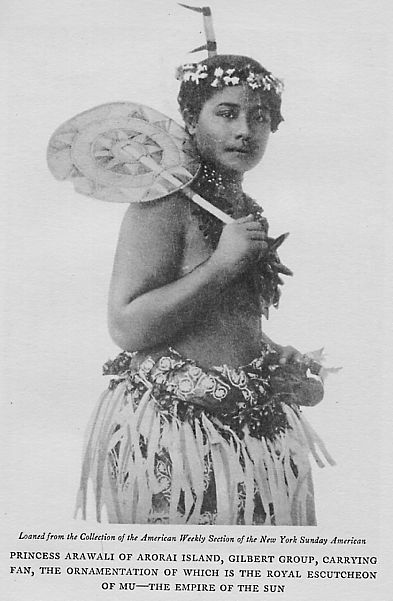
Well, not any more uncovered than she already appears in the 1926 Lost Continent of Mu Motherland of Men by James Churchward as shown below.


from page 47 of Lost Continent of Mu Motherland of Men

Here is the text concerning Princess Arawali:
Page 46:

The accompanying picture is one from a brown race, Arawali, a native of Arorai Island of the Gilbert group, which lies about 4,000 miles southwest of Hawaii.
The picture shows a young lady with an extremely well shaped and well developed head, of pleasing countenance and gentle expression. It has been said of her that “she is a very gentle, lovable woman, but quick-tempered and slightly jealous, but very dignified notwithstanding her wretched surroundings. She is the daughter of the King of Arorai Island.”
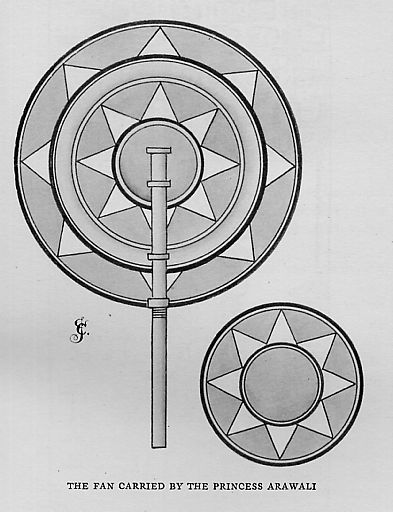
Arawali’s head and face belong to the representative of a high type of civilization, although her dress is that of a savage. Poor Arawali! She is one of a tribe of cannibals, but, strangely enough, she herself has never tasted “long-pig,” the euphemistic name applied to human flesh by the natives. In her hand she carries a fan, the ornamentation of which is the royal escutcheon of Mu?the Empire of the Sun.
No ancient record has ever been found that mentions savagery as existing on any spot of the earth’s surface prior to the destruction of Mu. Then why did such magnificent specimens of man as the forefathers of the South Sea Islanders become degraded cannibals? Our story of the great calamity that overtook the first race of man answers this question.


from page 49 of Lost Continent of Mu Motherland of Men


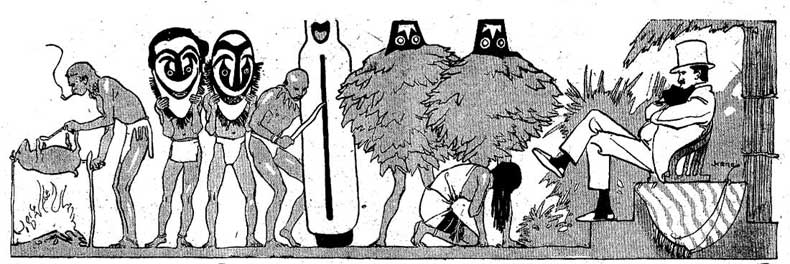
Thanks to the help of historian Yannis Deliyannis, creator and maintainer of the Chronicon Mirabilium blog, he has found an article in the March 26, 1911 edition of the American Weekly magazine section of the San Antonio Light entitled “My Home Life as a Cannibal Island King” and passed it along.


Some excerpts from the 03-26-1911 San Antonio Light (American Weekly Section)

“My Home Life as a Cannibal Island King”
Ex Wall Street Stock Broker, Now a King, Tells How It Feels to Have Numberless Adoring Wives and Rule Over a Race of Hearty Eaters


Arawali from the March 19, 1911 American Weekly Section of the San Antonio Light

The article begins:
“Archibald C. Everett, a former Wall Street stock broker, man about town, Beau Brummel and boulevardier of two continents, has become king of Aroral in the South Sea Islands…
“At last he came to Aroral, in the Gilbert Islands. It is in the midst of of the stupendous maze of islands scattered throughout the Southern Pacific. It is 1,500 miles from Samoa, the neaest place where there are extensive evidences of western civilization.
Mr. Everett fascinated old King Rovaka of Aroral. His handsome appearance, his smart clothes, his easy , genial manner, cultivated in Wall Street and the Gay White Way, captivated the venerable monarch. He begged Mr. Everett to consider everything on his island his, gave him his favorite and handsomest daughter in marriage and named him heir to the throne…
“Home, Sweet Home”
By Archibald C. Everett
Domestic life here is entirely free from the worries that accompany it in the United States and most European countries.
Here I find that a girl not only considers it an honor to marry me, but it costs me nothing and contributes to my support as far as it lies in her modest power.
During the six years I have been king of this island I have never refused to marry a girl, old or young, rich or poor. This, I believe, is the chief secret of my hold on my warm-hearted people.
At least once in each month I take a fresh bride, but I have no rule against admitting larger numbers to my household. Sometimes it happens that I receive as many as a dozen at a time. Families are large and rapidly growing in these islands. Whenever a father has a marriageable daughter he does not know what to do with, he presents her to me as a mark of his loyalty. It is an ancient custom, and I cannot but respect it.
The ceremony is always an occasion for a joyful gathering of the people of this and neighboring islands. Then they display their picturesque native customs. Wreathed in in hibiscus flowers and smiles, men, women and children dance and sing and pledge my health in cocoanut wine for three whole days and nights.
You must not suppose that the frequent acquisition and exchange of wives is destructive of permanent domestic affection. My darling Arawali, the only daughter of the late King Rovaka, has always remained my permanent and most beloved wife. She was the old king’s favorite daughter, and when I married her he named me his successor on the throne.
She presides over my household with perfect grace and modesty, never doing anything to disturb my peace and comfort, or that of my newer wives.
My wives are recruited from daughters of neighboring kings and leading chiefs of this island, and even from daughters of poor fishermen, why by their pleasing manners and appearance, may gain a place in my household. They are happy, simple, unaffected little creatures, whose only object in life is to minister to my pleasure and win my approval…


Observations

  • Most certainly the Arawali mentioned in the American Weekly magazine article from March 1911 is the same as mentioned in the 1926 ‘Lost Continent of Mu Motherland of Men.’
  • There are, however, some differences in the description of Princess Arawali between the accounts.
    James Churchward describes her as

    “she is a very gentle, lovable woman, but quick-tempered and slightly jealous, but very dignified notwithstanding her wretched surroundings. She is the daughter of the King of Arorai Island”

    Mr. Everett describes her as having

    “perfect grace and modesty and never doing anything to disturb his peace or comfort.”

  • Another point brought up in the American Weekly article is:

    “As I never question the right of my people to observe their ancient customs, so they never expect me to share in those that are repugnant to me.”

    This is as close to mentioning cannibalism/savagery that the article comes, except for the title of the article “My Home Life as a Cannibal Island King.”

  • Everett proclaims in the American Weekly article that he had been King for six years. According to an article in the New York Times dated February 16, 1911, it mentions that he was elected King “two years ago” or 1909.
  • Sadly, on July 14th, 1913 the New York Times delivered a message under the title, “ONLY YANKEE KING IS READY TO QUIT” from Archibald Everett, King of Arorai Island to say that he was no longer happy.
    The most obvious aspect of this revelation is that the American Weekly article may have taken liberties and perhaps stretched the truth a little. Perhaps when writing his account, Archibald felt that his then-current station in life was required to be embellished so as to remove the implied stain of his past financial failures.
  • Obviously, James Churchward was reading and consulting the American Weekly section of his local newspaper as early as 1911 or fifteen years before the 1926 publication of “The Lost Continent of Mu Motherland of Men”. This is not to say that James read the article in a Texas newspaper, the American Weekly was distributed every Sunday in newspapers owned by the William R. Hearst Corp. James probably read his copy from the New York American.

I also have no information about Mr. Everett’s life after July 1913, whether he ever visited his friends, brought his Princess bride to the United States, or what happened.
If any readers know what became of Archibald C. Everett or Princess Arawali, please pass it along and we’ll complete the record.

Have a great day,
Jack Churchward
Clearwater, Florida