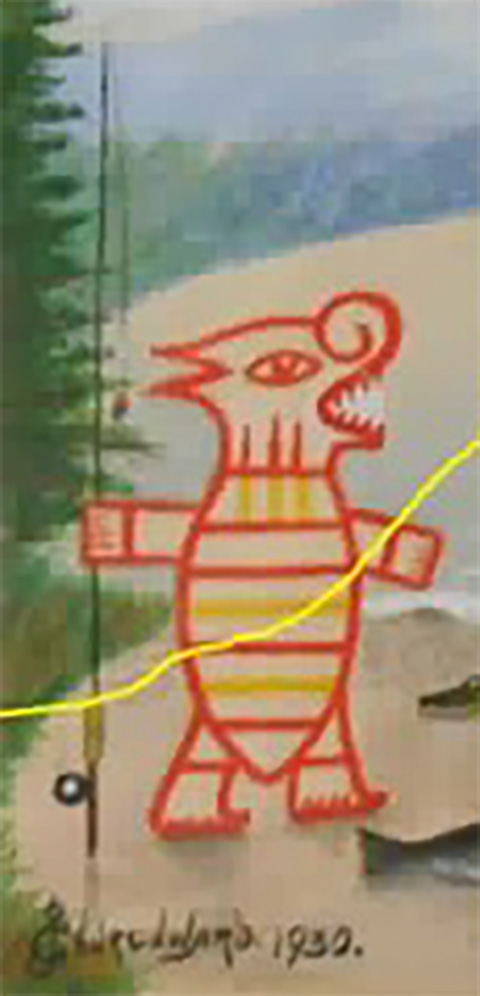
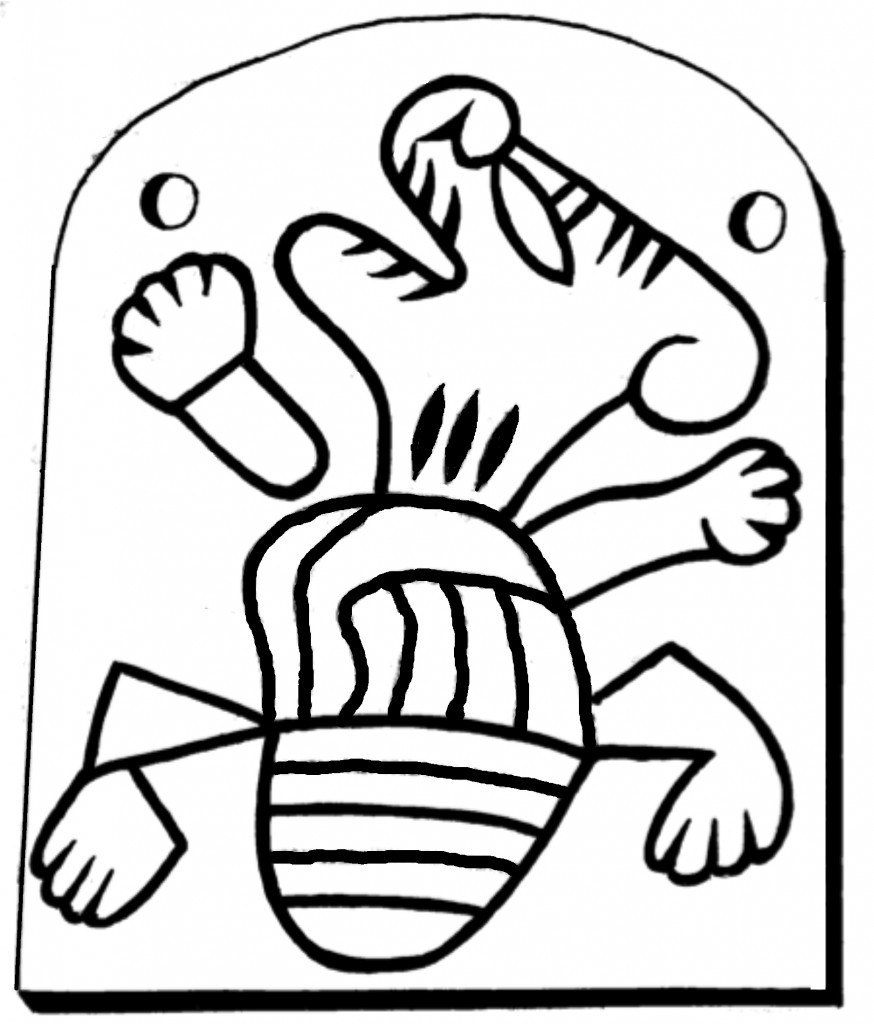
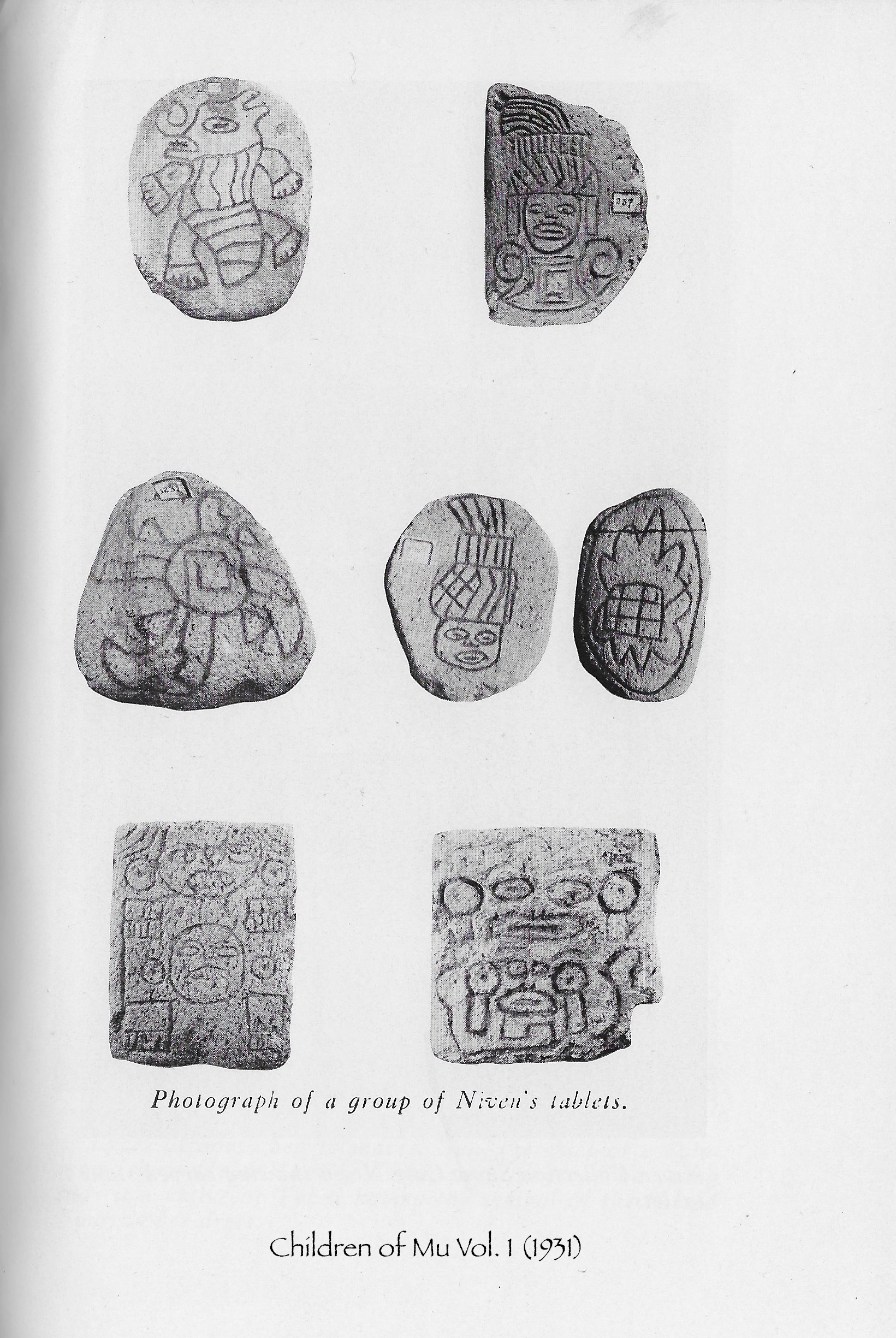
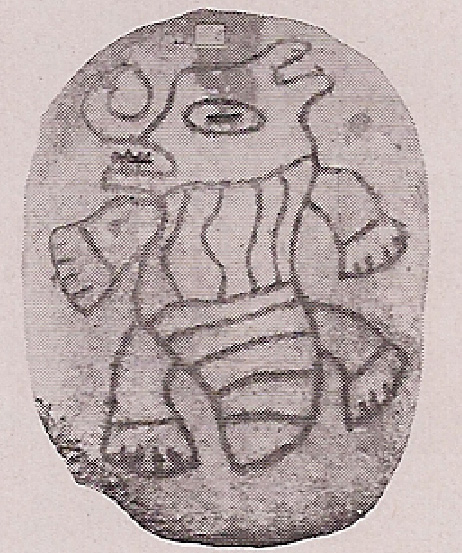
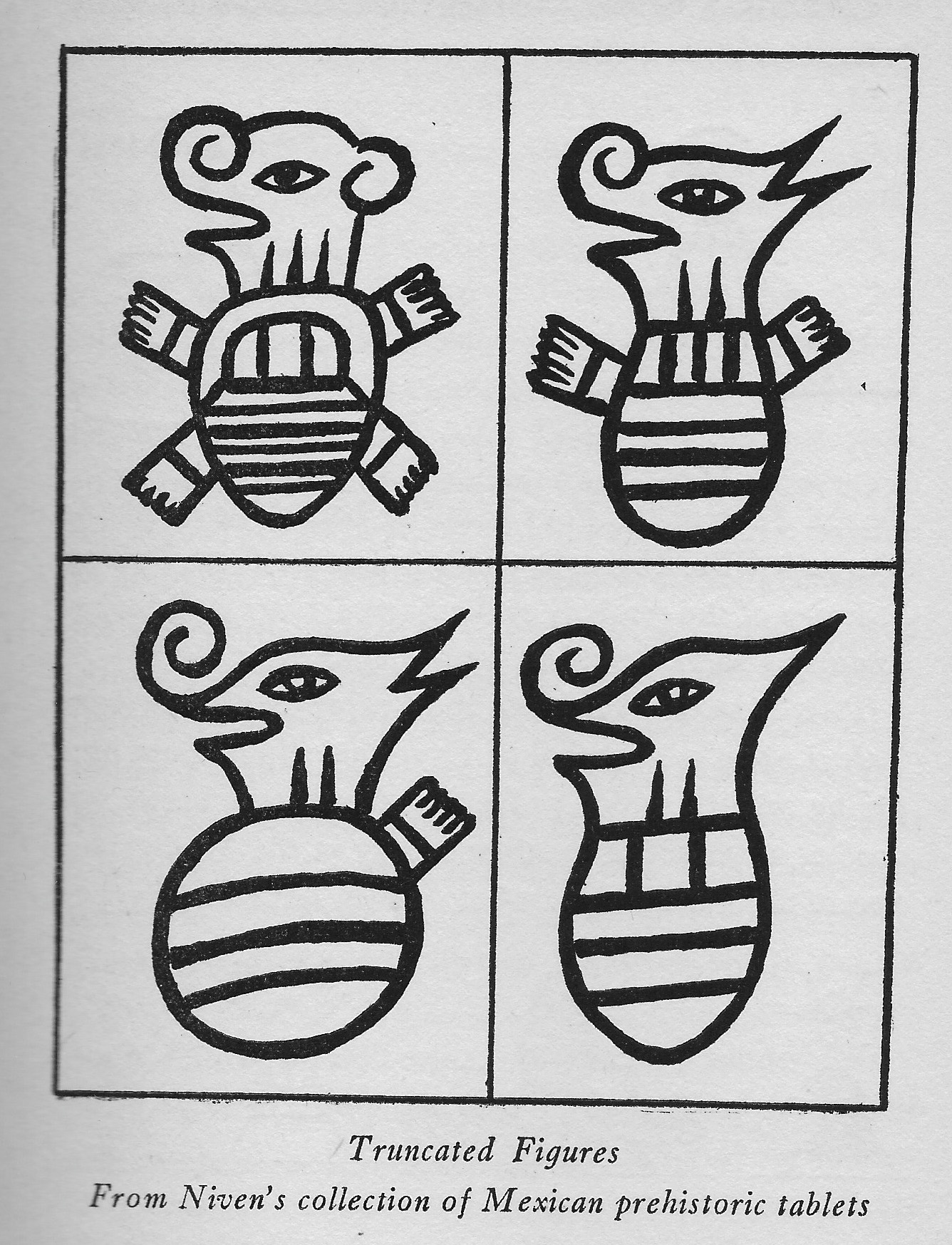
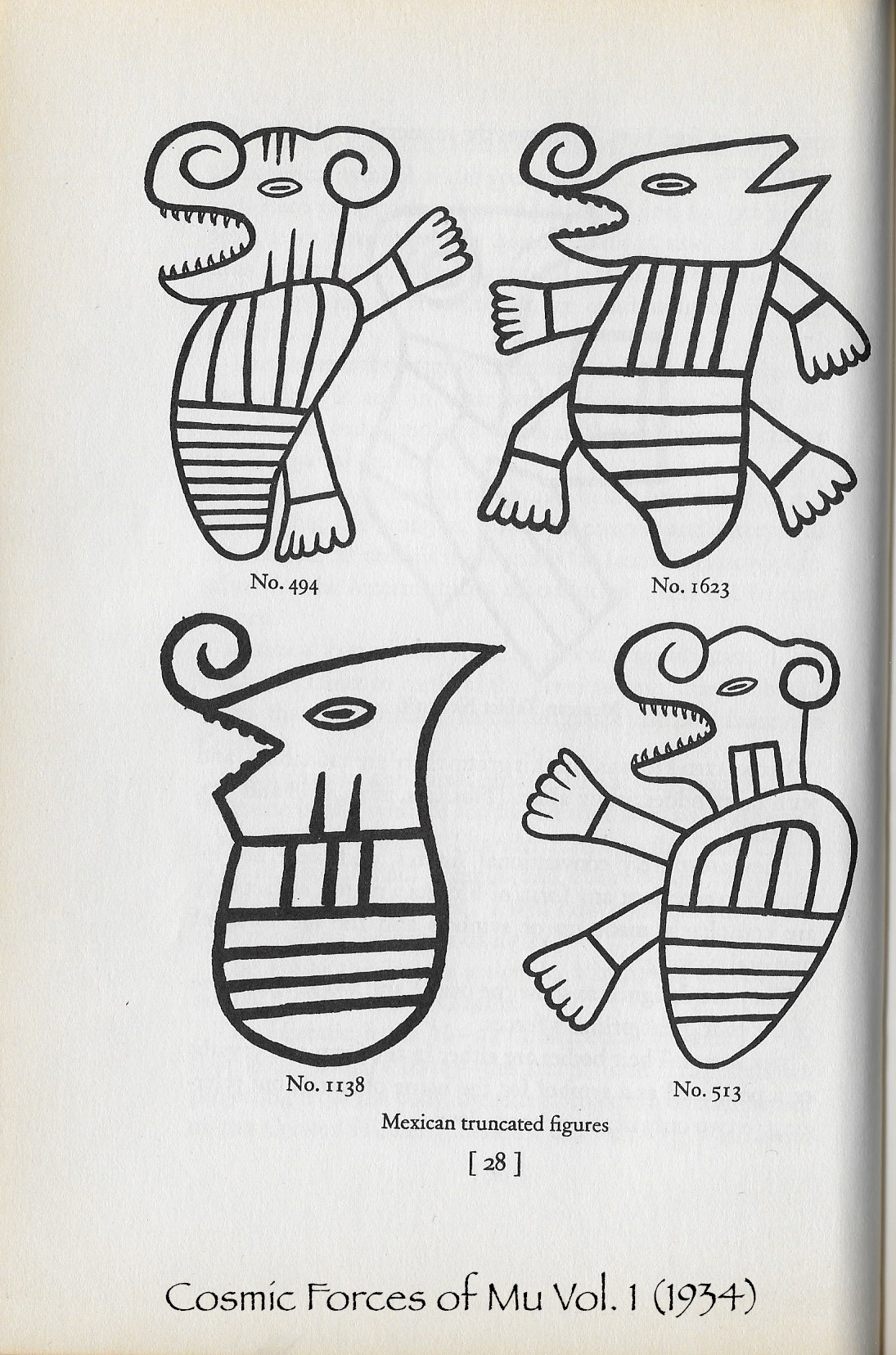
In a previous blog posting “I Found the Critter,” I connected the fact James based the brightly colored character on some drawings to the “truncated figures” mentioned and explained in a few of James’ books. They are from Niven’s Mexican Tablets and in each different expression represent the interactions of what James calls the “Four Primary Forces.”
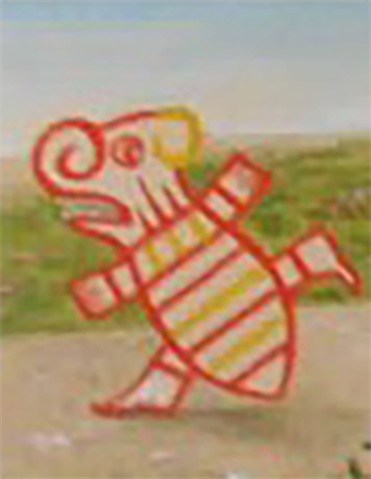
Subsequently (as is many times the case,) new information arises to update and provide a more complete picture. Thanks to a tip or two from a reader, I was pointed to artwork sales explaining the “Critter” or more correctly, the ‘Pixeyite.’ James used the figures from Niven’s tablets as characters in short painted works to mock and/or satirize the views held by his critics.
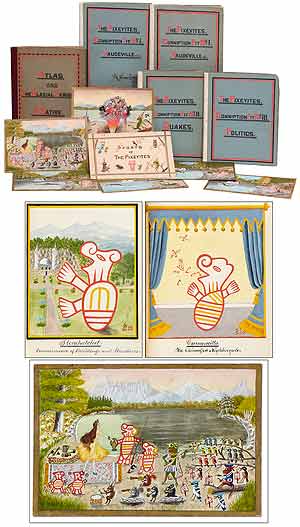
According to: The Pixeyites: Original Manuscript and Artwork Satires by James Churchward or the captured webpage image.

CHURCHWARD, James
The Pixeyites: Original Manuscript and Artwork Satires by James Churchward
(Mount Vernon, New York): (1925-1935).
Sold (date unknown)
Softcover. A highly unusual collection of satirical illustrated manuscript stories, several series of satirical gouache paintings, a series of painted symbols, and other artworks and letters by the British-born engineer, inventor, and occult writer James Churchward. Churchward’s remarkable cast of satirical figures, known collectively as the Pixeyites, are ostensibly based on the Niven stones, which were pre-Columbian stone tablets bearing indecipherable pictographs and related markings, unearthed in 1921 by the English mineralogist William Niven in the Valley of Mexico. Most of the original 2600 andecite tablets were lost or dispersed and have never been recovered. All that remains are Niven’s original rubbings, a selection of which are here stringently reproduced by Churchward as dramatic satirical figures superimposed upon new landscapes, timelines, and situations, thereby endowing them with a new life of their own. Now, they are “Pixeyites” – each unique figure strikingly realized with humor and wit (no doubt inspired by the mythical “Pixies” believed to inhabit Neolithic sites in and around Cornwall and Okehampton, Devon, where Chuchward was born).
The collection consists of five quarto volumes: each handwritten in ink and illustrated with gouache paintings (totaling 272 foliated leaves with 96 full-page paintings of individual Pixeyite figures and many other painted illustrations); four sets of satirical gouache paintings, most of which depict the Pixeyites engaged in all sorts of outdoor “sports” and “frolics” (totaling 72 unique artworks, most on 6” x 9” sheets); and one set of 22 hand-painted “Symbols of the Four Primary Forces.” Also included is a small cache of letters from Churchward to two young ladies whom he befriended a few years before his death in 1936. All of the paintings are signed with Churchward’s hand painted signature or monogram. Many of the individual gouache paintings have manuscript descriptions in pencil on the back. The set of “Symbols” have manuscript descriptions in ink. The five quarto volumes are in painted wraps with quarter cloth backstrips. The first volume (“Atlas”) has a few small holes in the margins of two paintings (not affecting the images), else all five volumes and all of the other artworks are in fine condition.
The paintings were created over an eight-year period, during which Churchward won international notoriety for his book: *The Lost Continent of Mu – Motherland of Man* published in 1926, in which he claimed to have proved the existence of a lost continent, called Mu, in the Pacific Ocean. In that work Churchward presents his theory that a set of ancient tablets which he discovered in India (the Nacaal tablets), as well as Niven’s set of stone tablets from Mexico, both originated from the lost, antediluvian civilization of Mu. He claimed Mu was the site of the Garden of Eden and home to an advanced civilization. Whereas in this and other books by Churchward, in which he attempts to support his claims with scientific arguments, in *The Pixeyites* he takes imaginative delight in attacking the scientific establishment of the day by depicting the pre-Columbian symbolical figures as members of the “Chimalpa Vaudeville Club; composed of members of the Pixey Town Scientific Society.”
Among the five quarto volumes, the first is comprised of three parts dating from 1925-1927, and is titled: *Atlas and The Glacial Period. A Satire*. The other four volumes are titled: *The Pixeyites*. They are continuously foliated and dated from 1928-1929, with the following sub-titles: *Conniption Fit No. 1. Vaudeville A*; *Conniption Fit No. 1 Vaudeville B*; *Conniption Fit No. 2. Quakes*; *Conniption Fit No. 3. Politics*. In his forward to *Conniption Fit No. 1. Vaudeville A*, Churchward writes: “All of the figures in this satire are exact reproductions of symbolical figures found … at Chimalpa, Remedios, San Miguel, Amantla, Santiago, Ahuizotla, and other nearby villages from 4 to 6 miles north-west of Mexico City. Not a line had been added or altered in the figures themselves. Here and there I have added something as coming from their mouths and have drawn scenes around many of them suitable to the character given them … .”
Churchward skillfully recreates the stone symbols by placing them in a variety of whimsical environments (English tea rooms, volcanic landscapes, icy tundra, verdant moorlands): all of the paintings are accomplished and visually striking, many have elaborate ornamental borders in the style of a Persian miniature. The personas given to the figures themselves are rarely flattering. Several are quack scientists with names like “Dr. Bighead,” and they are depicted by Churchward in his written satire as espousing illogical arguments, misunderstanding concepts, backbiting, and fighting one another. Churchward insists that these elaborate volumes were never meant for publication, but were created “simply … to amuse my friends when they visit.” As he had clashed with the scientific community, so too do the stark, abstract symbolic figures clash with their lush, formal environments. The resulting aesthetic is whimsical and surreal, bordering on Dada.
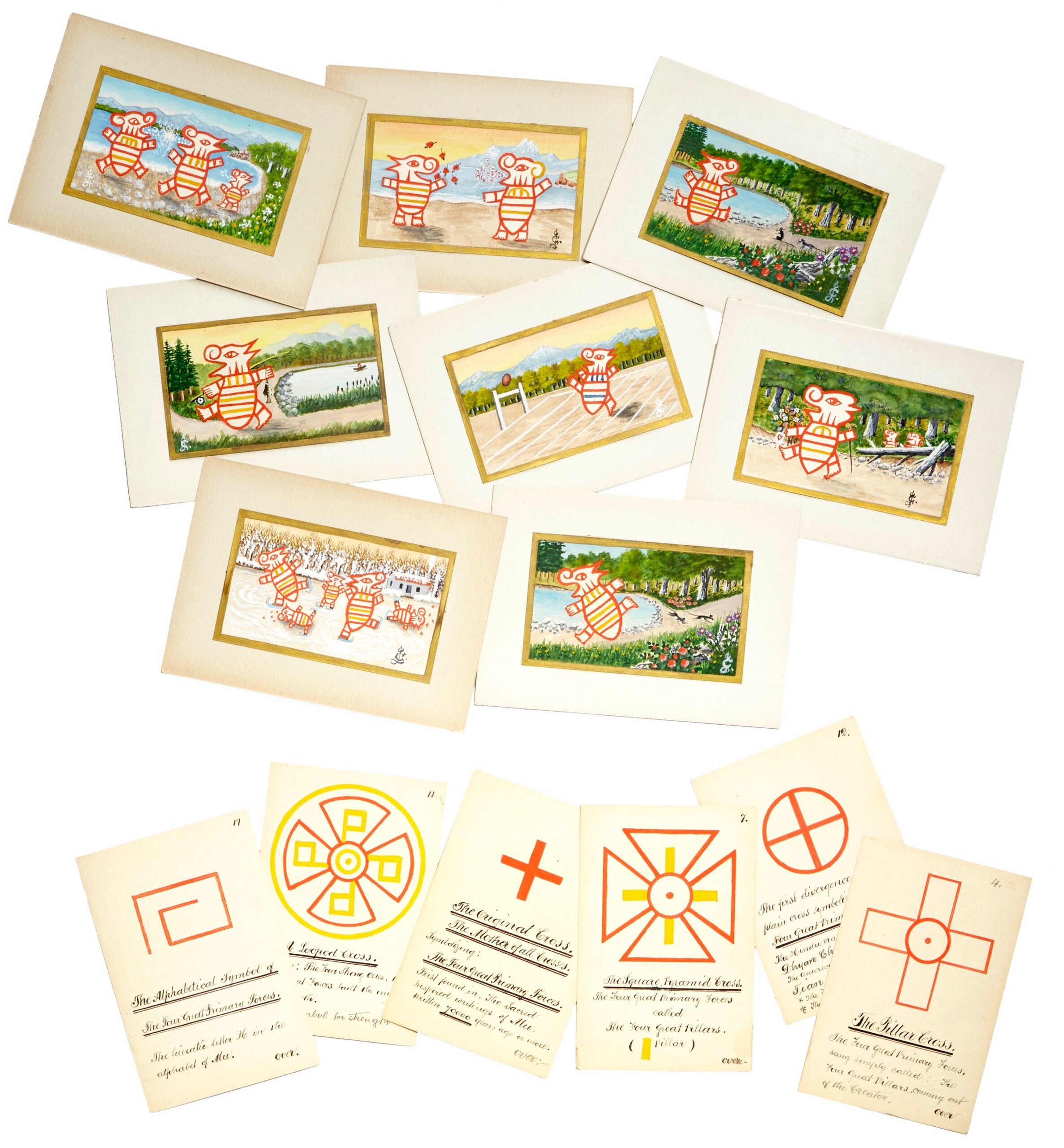
The same can be said about the four sets of satirical gouache paintings and other loose artworks. One set titled: *The Frolics of the Pixeys* consists of 23 paintings assembled by Churchward into an album which he gave to his friend Nina Gade: “These rough sketches were made for you as a Christmas present. Hoping that you will get some sort of a kick out of them.” Among the other three sets of loose paintings, one is titled: *Sports of the Pixeyites* (consisting of seven paintings); one bears a combined title consisting of 24 paintings: “The Tale of the Swordfish: for Sally” and “The Tale of the Busted 18th: for Nina*; and one consisting of 15 paintings is untitled. Most of these 72 artworks depict the Pixeyites (individually and in groups) and other members of the “Pixeyite Club” (various animals and birds, including a large frog named “Dr. Croaker”) engaged in all sorts of frolics and outdoor sporting activities: golfing and fishing (including several fishing mishaps), archery, woodland walks and serenading, sailing, skiing, skating, etc. There are three other loose artworks, including a large portrait of a Pixeyite walking a poodle, and a set of 22 hand painted symbols consisting of various Crosses and Winged Circles, including two symbols drawn from Niven’s Mexican tablets.
The entire collection of artworks could be rightfully seen as a continuation of the Mu Saga, and certainly shed a great deal of light on the puckish humor that Churchward deployees towards his critics. The Mu books remained in print for many decades and despite the skepticism they rightfully attracted, the saga continues to resonate with seekers of utopias, alongside tales of the lost worlds of Atlantis and Shangri-La. These manuscripts seem eminently suitable for publication. A detailed list is available on request.
Similarly, in 2015 another collection was sold at auction. Bonhams: Churchward, James, 1851-1936. Large collection of artwork and letters,… or the captured webpage image
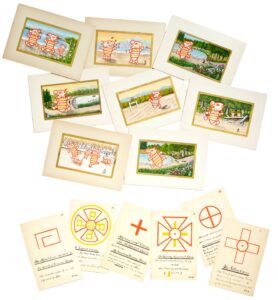
CHURCHWARD, JAMES. 1851-1936.
Large collection of artwork and letters, including:
1. “The Frolics of the Pixeys,” [Mount Vernon], 1931-2. Album containing title and 22 gouache on stiff paper illustrations, 6 x 9 inches, 3 x 5 inches, and one 8 x 10 inches, also with printed poem with hand-colored illustrations and a signed photographic portrait of Churchward, with typed narrative descriptions reproducing holograph descriptions on verso of illustrations, with presentation inscription from Churchward on 6 x 9 inch card, illustrations in excellent condition, album with wear to spine.
2. Group of 15 illustrations, gouache on stiff paper, 3 x 5 inches, mounted to 5 x 7 inches, [Mount Vernon, 1930s], most depicting Pixey characters, some mounts toned, else excellent.
3. “Symbols of the Four Primary Forces. ‘The Sacred Four’,” ink and gouache on 25 cards, [no date], being detailed descriptions of various symbols with gouache depictions, toned, lacking some of the series.
4. 23 original illustrations, gouache on stiff paper, 6 x 9 inches, [Mount Vernon], 1931-2, all but one depicting scenes with Pixey characters, holograph descriptions on verso, with dedication inscription to Sally and Nina, light edgewear, else excellent.
5. Original illustration, gouache on board, 6 x 9 inches, depicting a Pixey character walking a toy poodle, light edgewear, else very good.
6. 2 original illustrations, pen and ink and gouache on stiff paper, 4 1/4 x 4 7/8 inches & 4 x 5 1/4 inches, [Mount Vernon, no date], depicting a sea-side scene and the transformation of a caterpillar into a butterfly, very good.
7. 3 Autograph Letters Signed (“J. Churchward”), totalling 6 pp, and 1 Letter Signed (“J. Churchward”), 1 p, Mount Vernon, 1934-5, 3 with original envelope, to Nina Gade or Lea Hudson, and with a telegram and a signed Christmas card both from Churchward.
Occultist James Churchward is best known for his books on the lost continent of Mu, which according to him “extended from somewhere north of Hawaii to the south as far as the Fijis and Easter Island.” Over a decade into his retirement after receiving a settlement for patent infringement on NCV steel, he published the first book on Mu: The Lost Continent of Mu Motherland of Man. FIve more were to follow. The material here was all sent to two young women he had met and befriended on an ocean voyage. The illustrations are mostly colorful and whimsical, many depicting his own primitive Pixey characters engaging in various activities including fishing, one of Churchward’s favored pastimes, sports, and various frivolities, but also some related to his occultist work like the notes on ancient symbols. An interesting archive that should be seen.
Following the themes in his published works on the Lost Continent of Mu, James continued to cast shade on and denigrate his critics. In his books, the work and theories of other authors with decades of real hands-on experience and real college degrees would be dismissed with a sentence if it didn’t match his. The Pixeyite paintings/books continued on this trajectory, mocking and satirizing his critics. He offered no proofs, other than his interpretation of the ‘tablets’ found by William Niven – interpretations he alone presented without agreement from anyone, even William Niven.
As far as the veracity of Niven’s ‘Mu Stones,’ I would direct the reader to visit Dr. Jeb Card and the ‘Mu Stones’ to watch the interview with Dr. Card.
Have a great day






 RSS - Posts